As a drone program grows, so does the mess: folders of imagery, processing outputs in different formats, spreadsheets of measurements, dashboards nobody trusts. A lakehouse brings it together. Here's how that works with Databricks.
What a lakehouse is
A lakehouse stores data cheaply in open formats in the cloud (the lake), and adds the reliability of a database on top (the house): tables with schemas, versions and access control. In Databricks, those tables use Delta Lake.
How drone data fits
- Files stay files. Imagery, point clouds and models stay in cloud storage, in open formats like Cloud-Optimised GeoTIFF and LAZ.
- Metadata becomes tables. Each flight, sensor, site and output is a row you can query.
- Measurements become tables. Stockpile volumes, tree counts, zone health and defects, one row per thing per flight.
- Answers become tables. Weekly volume change, zones needing attention, defects by severity.
Why it helps
- One source of truth. Every dashboard and report reads the same tables.
- History. Delta tables keep versions, so you can see what a number was last month and why it changed.
- Reprocessing. Improve a method and rerun it over all past flights.
- Governance. Control who sees which sites and clients.
- Scale. Process hundreds of flights in parallel when needed.
A simple structure
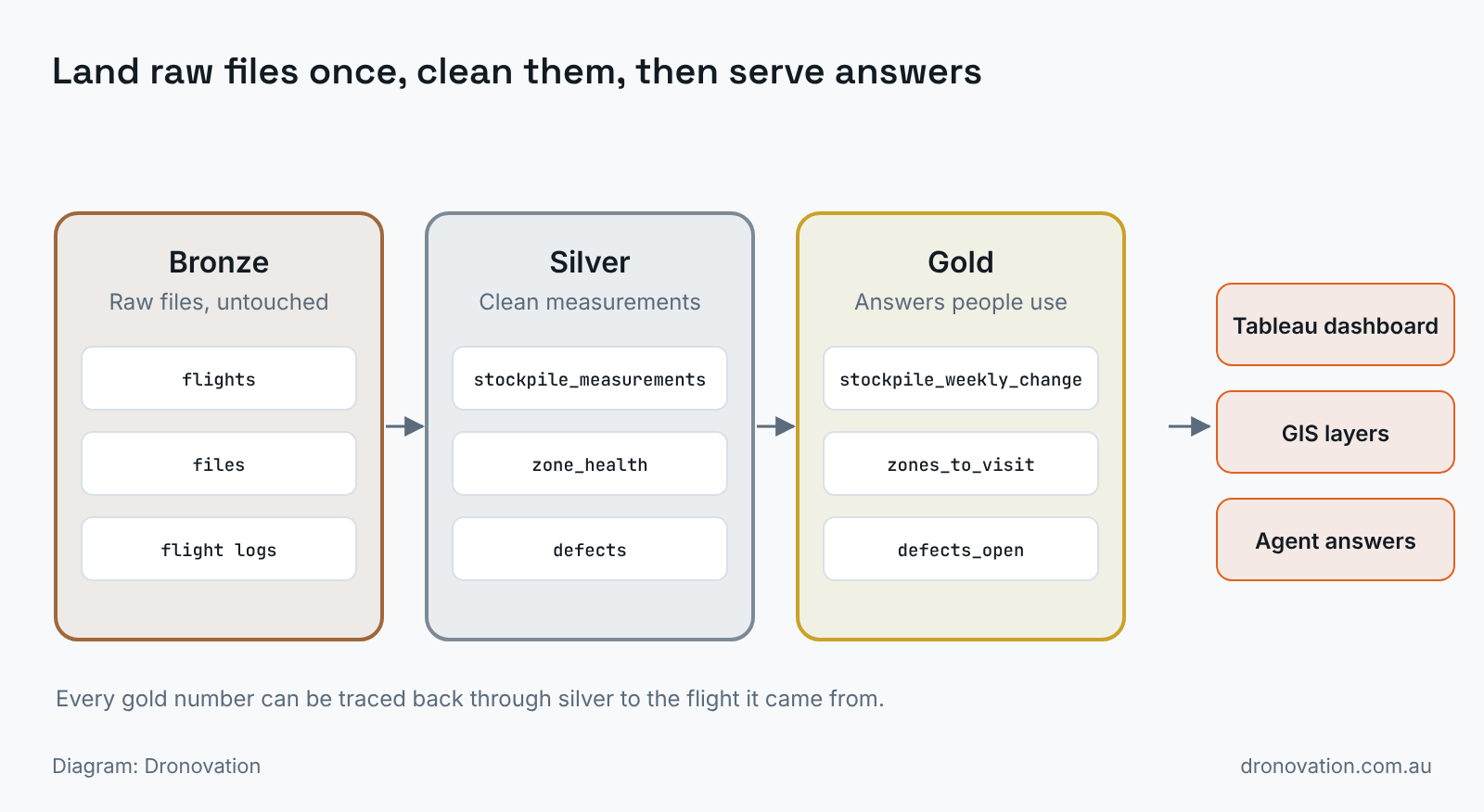
- Bronze: flights, files, flight logs
- Silver: stockpile_measurements, zone_health, defects
- Gold: stockpile_weekly_change, zones_to_visit, defects_open
Where AI fits
With clean gold tables, an AI agent can answer questions like "which stockpile grew most this month?" by writing a query, running it and showing the result. Because it reads governed tables instead of guessing, every answer can be checked.
Our flight-to-dashboard demo uses this structure with Lumina Metric and Lumina Fields data.