Australia lets many businesses fly drones for work without a remote pilot licence or an operator's certificate. This is called the excluded category. It's simple, but it has firm limits.
Who it's for
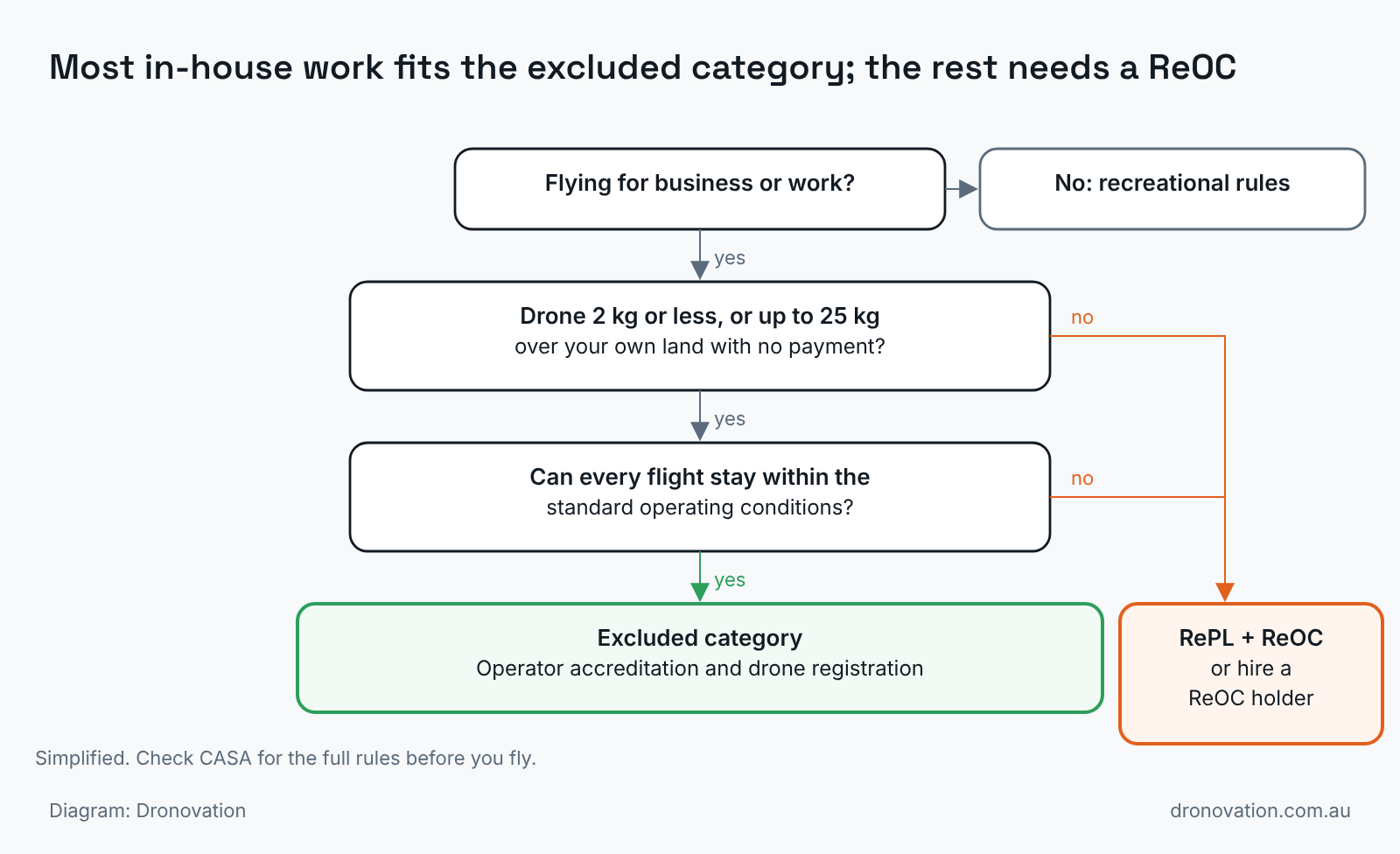
The excluded category covers commercial flying with:
- Very small drones: more than 250 g and up to 2 kg, for business or as part of your job
- Small drones over your own land: 2 to 25 kg, over land you own or lease, with no payment for the services (sometimes called the landholder category)
Micro drones (250 g or less) used for business follow similar steps.
Typical users include photographers, real estate agents, tradespeople, builders, researchers, councils and farmers.
What you need
- An aviation reference number (ARN) for each person, and an organisation ARN for a business
- Operator accreditation: a free online course and quiz, valid for three years
- Drone registration for every drone used for business
- The standard operating conditions, every flight
The standard operating conditions
- Fly only by day
- Keep the drone within your own visual line of sight, not through a screen or goggles
- Stay at or below 120 m (400 ft) above ground level
- Keep at least 30 m from people who aren't part of the operation, and don't fly over or above people
- Fly one drone at a time
- Stay out of prohibited and restricted areas, and away from controlled aerodromes and their approach and departure paths
- Don't fly over or near emergency operations
Records
For very small drones (2 kg or less) in the excluded category, CASA doesn't require operational records. Small and medium drones flown over your own land do need logs: an operational log, a pilot log and a technical log, with the operational log kept for three years. Keeping a simple log anyway is good practice; it protects you if something goes wrong.
Where people get caught out
- Weight creep. Adding a sensor or bigger battery can push a 1.9 kg drone over 2 kg.
- Crowds. The 30 m rule makes many events and busy streets off limits.
- Airports. Much of every capital city is near a controlled aerodrome. Check a CASA-verified drone safety app before every job.
- Payment. The landholder category doesn't allow you to charge others for the flying.
If your work regularly pushes against these limits, it's time to look at a remote pilot licence and a ReOC.
General information only. See CASA's drone weight categories and requirements for the current rules.