Almost every drone runs on lithium batteries. They pack a lot of energy into a small space, which is why drones can fly for half an hour. Treated badly, they lose capacity fast, and occasionally catch fire. Here's how to look after them.
The basics
Drone batteries are lithium-polymer (LiPo) or lithium-ion (Li-ion) packs made of several cells in series. Many modern drones use smart batteries with a built-in management system that balances cells, tracks cycles and discharges itself to a storage level. Simpler packs leave that to you and your charger.
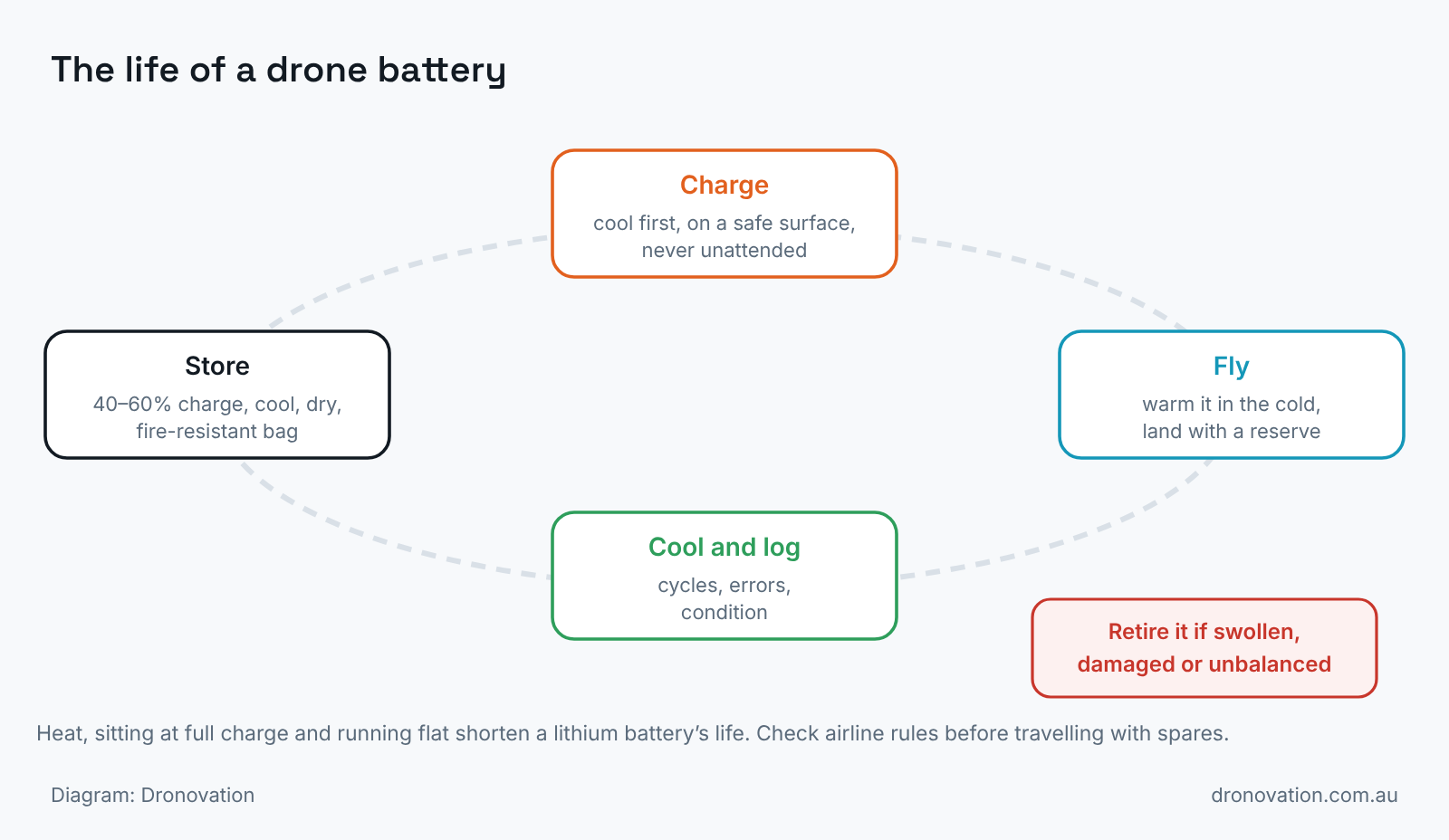
Three things shorten a lithium battery's life: heat, sitting at full charge, and running it flat.
Charging
- Use the manufacturer's charger, or a quality balance charger set for the right chemistry and cell count
- Let a battery cool after flying before you charge it
- Charge on a non-flammable surface, away from anything that burns, and don't leave it unattended
- Don't charge a battery that's swollen, damaged or very cold
- Charge close to when you'll fly, not days before
Storage
- For storage longer than a few days, keep batteries at a storage charge, roughly 40 to 60%. Smart batteries can do this automatically; set the self-discharge time in the app.
- Store somewhere cool and dry, not in a hot car or ute
- Use a fire-resistant bag or box, especially for larger packs
- Check stored batteries every month or two and top them back up to storage level
Cold weather
Lithium batteries deliver less power in the cold, and voltage can drop suddenly under load. In winter or at altitude:
- Keep batteries warm until take-off, for example in an insulated bag
- Hover for a minute before climbing to let the pack warm up
- Plan shorter flights and land with a bigger reserve
- Watch the voltage, not just the percentage
Travel and transport
Lithium batteries are dangerous goods when you fly on an airline. Rules are set by the airline, CASA's dangerous goods rules and international standards, and they change. In general, spare batteries go in carry-on, not checked luggage, with terminals protected, and larger batteries need airline approval or can't be carried at all. Check your airline's rules and CASA's guidance before every trip.
When driving, carry batteries in a protective case, at storage charge if you're not flying that day, and keep them out of direct sun.
When to retire a battery
Retire a battery if it:
- is swollen or puffy, even slightly
- has a damaged case or connector
- shows a big voltage difference between cells
- no longer gives a reasonable flight time, or reports errors
- has reached the cycle count the manufacturer recommends
Discharge it fully (many chargers have a discharge mode) and take it to a battery recycling drop-off. Never put lithium batteries in household rubbish.
Keep a battery log
Number every battery and log its cycles, any errors and its condition. For a business, the log shows which packs are tired before they fail mid-job, and supports your maintenance records.
General information only. Follow your manufacturer's instructions and check current dangerous goods rules before travelling.